











Melatonin gummies are the default. They're in every pharmacy, every airport, every bedside drawer. Melatonin inhalers are newer, and the comparison people want isn't a sales pitch — it's a straight format-versus-format breakdown.
So here it is, with one important framing note first: these two things are not in the same regulatory category, and that's the most consequential difference between them. Everything below follows from it.
The one difference that explains the rest
A melatonin gummy is an ingestible dietary supplement. It's swallowed, digested, and it sits inside a well-defined regulatory framework with labeled amounts per serving and structure/function claims permitted on the label.
A melatonin inhaler is not ingestible. It's an inhaled diffuser device that contains melatonin among its ingredients. Because it isn't swallowed, the claims that apply to ingested melatonin supplements don't transfer to it — and any brand telling you an inhaler does what a gummy does is telling you something it can't support.
We're going to be scrupulous about that line in this article, which means we'll tell you what each format is and let you draw the conclusions.
What melatonin is, generally
Setting products aside entirely for a moment.
Melatonin is a hormone produced naturally by the pineal gland. Its production follows a daily rhythm, rising in the evening as ambient light falls and declining toward morning — which is why it's commonly described as part of the body's sleep-wake cycle signaling. It's one of the most-studied compounds in the consumer supplement space, and it's found in small amounts in some foods, including tart cherries, pistachios, oats and grapes.
That's general background about the compound. It is not a statement about any HealthVape product.
Format-by-format comparison
| Melatonin gummies | Melatonin inhalers | |
|---|---|---|
| Route | Swallowed and digested | Inhaled |
| Category | Ingestible dietary supplement | Non-ingestible diffuser device |
| Typical labeling | Milligrams per gummy (commonly 1–10mg) | Not labeled as a per-serving supplement dose |
| Sugar / calories | Usually contains sugar or sweeteners; some sugar-free | None |
| Other ingredients | Gelatin or pectin, sweeteners, colorings, flavors, sometimes L-theanine or chamomile | Vegetable glycerin base, food-grade flavoring, herbal or vitamin ingredients |
| Portability | Bottle; can melt in heat | Pocket-sized pen or pod device |
| Repeatable use | Discrete, countable doses | Device-based, not dose-counted |
| Ritual | Take-and-done | Inhale-exhale pause, closer to a wind-down routine step |
On "onset" — what can and can't be said
This is where most articles on this topic get sloppy, so let's be precise.
For ingested melatonin, the pharmacokinetics are studied: it goes through the digestive tract and first-pass liver metabolism, and standard-release oral melatonin is generally described in the literature as reaching peak blood levels somewhere in the range of roughly 30–60 minutes, varying substantially between individuals and formulations. That's why gummy labels typically suggest taking one some time before bed. (We go deeper on the timing side in how long melatonin lasts in your system.)
For inhaled melatonin in a diffuser device, we're not going to give you a number, because we don't have one we can stand behind and neither does anyone else selling you one. There isn't a robust body of published pharmacokinetic research on melatonin delivered this way, and a brand quoting you a precise onset time for an inhaler is inventing it. What we can tell you factually: our melatonin pens and pods contain melatonin, and they are not measured or labeled as supplement doses.
If a specific, labeled, studied amount of melatonin is what you're after, a gummy or tablet is the format built for that. That's a genuine advantage of the ingestible format and we're not going to pretend otherwise.
Where an inhaler makes more sense
There are real reasons people choose the inhaler format, and none of them require an efficacy claim.
It fits a wind-down routine rather than a supplement schedule. Gummies are a thing you take. An inhaler is a thing you do — for a minute, in the dark, before bed. For people who already have an evening ritual (or who are building one, see our evening wind-down guide), that difference is the whole appeal.
No sugar, no calories, no gelatin. Relevant if you're eating a nightly gummy, or if you avoid gelatin.
It replaces a hand-to-mouth habit. This is the big one, and it's why melatonin pens are popular with people moving away from nicotine devices. A gummy doesn't occupy the same behavioral slot. An inhaler does.
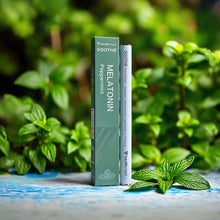
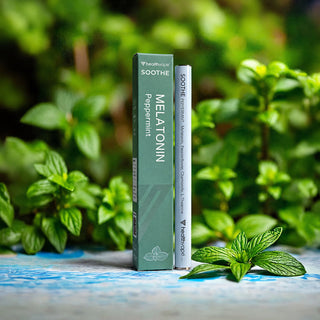
Flavor is part of the experience. Our melatonin pens come in lavender, jasmine and peppermint, and the relaxing pods range includes peach chamomile, lychee chamomile and kumquat GABA + kava. That's a sensory choice, not a dosing one.
Where a gummy makes more sense
- You want a specific labeled amount of melatonin
- You'd rather not inhale anything at all — a completely fair position
- You're following a doctor's or pharmacist's guidance about a particular amount and timing
- You want the cheapest possible per-night cost
Practical notes if you're considering an inhaler
- Treat it as part of the routine, not the mechanism. Dim lights, screens down, then the device. The routine is doing more work than any single element in it.
- Keep it separate from your daytime formulas. If you also use a caffeine pen, don't leave them in the same pocket at 10pm. Sounds obvious; happens constantly.
- A rechargeable kit is cheaper if you use more than one formula. Pods let you run a chamomile or melatonin formula at night and something else in the morning on the same device.
- It contains no nicotine. Zero, in every HealthVape formula.
You can see the full melatonin range on the melatonin inhaler collection, and the broader chamomile, GABA and herbal lineup in herbal inhalers. If you'd rather approach the whole thing through food, we also wrote up foods that contain melatonin.
The bottom line
Gummies and inhalers aren't competing versions of the same product. A gummy is an ingestible supplement with a labeled amount. An inhaler is a non-ingestible device containing melatonin, built around flavor and routine, with no dose label and no dose claim.
If you want a measured amount, buy the measured format. If you want something to do in the last twenty minutes of the day — something with no sugar and no nicotine in it — that's the case for the inhaler, and it's the only case we're going to make.
This article is general information, not medical advice. HealthVape products contain no nicotine, are not ingestible supplements, and are not intended to diagnose, treat, cure or prevent any disease. Talk to a healthcare professional about melatonin use, especially if you're pregnant, nursing, taking medication, or considering it for a child. Not for use by minors.


